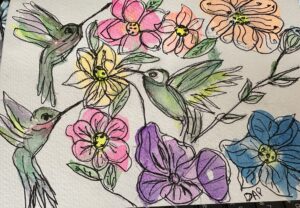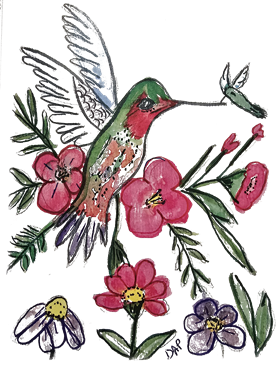
Of all the designs in the Hummingbird Whispers collection, the hummingbird is the one people ask about most. Not just because of what it looks like — though Debra hears regularly that it's the card people keep — but because of what they sense is behind it. There is something in the painting that feels personal. Considered. Made for something more than a commercial print run.
That sense is accurate. The hummingbird is Debra's signature design, the one that gave the collection its name, and the one she has returned to again and again as the clearest expression of what Hummingbird Whispers is actually about. This is the full story of how it gets made.
Why the Hummingbird
Hummingbirds are not easy subjects. They are small, fast, iridescent — their colors change depending on the angle of light, and their hovering stillness is actually a kind of controlled urgency. Painting one in watercolor requires holding two things in tension at the same time: the softness of the medium and the precision of the subject.
Debra chose the hummingbird as her signature design because of what the bird has meant in her own life. In many cultures — including several with roots in the regions she has lived and worked — the hummingbird is associated with joy, lightness, and the idea that something beautiful can arrive even in hard moments. When she began thinking about what kind of cards she wanted to make, and who she wanted to make them for, the hummingbird kept returning.
The design has evolved over time, as Debra's watercolor technique has developed. But the core of it — a hummingbird in flight, rendered in soft blues and greens and the particular iridescent ruby of its throat — has remained consistent. It is recognizably a Debra painting. That's intentional.
Step One: The Reference and the Sketch
Every hummingbird painting begins with observation. Debra keeps photographic references — hummingbirds at feeders, in gardens, in the particular posture of hovering flight — but she doesn't copy from them directly. The reference is a prompt, not a template. She is looking for the gesture of the bird: the angle of the wing, the tilt of the head, the way the tail feathers spread slightly when hovering.
The pencil sketch comes next. It's light — barely visible on the watercolor paper — because heavy pencil lines bleed through the transparent washes of color and muddy the finished painting. Debra sketches the main shapes: the body, the wings at their spread, the long beak that is itself a kind of precision instrument. The sketch takes perhaps ten minutes. The painting will take an hour or more.
- The angle of the body — hummingbirds hover at a slight forward tilt, not perfectly vertical
- Wing position — at the top of the stroke, wings angle back; at the bottom, they sweep forward
- The relationship between the beak length and the body — this proportion determines whether the bird reads as a hummingbird or something else
- Negative space — the shape of the air around the bird matters as much as the bird itself
Step Two: The First Washes
Watercolor works in transparent layers — light to dark, broad to specific. The first wash on the hummingbird is the background: a soft blend of blues and greens that establishes the tonal mood of the painting. Debra works wet-on-wet for this stage, letting the colors bloom and blend on the damp paper surface. The result is never identical to the last painting. That's part of what makes each one an original.
This is the stage that most surprises people who watch the process. The first wash looks nothing like a hummingbird — it looks like weather. Like sky seen through glass. The painting won't begin to resolve into what it's becoming for another twenty minutes, after the first layer dries and the second begins.
The body of the bird comes next: a deeper green, laid down with a medium brush, following the pencil outline. Watercolor dries lighter than it appears when wet. Debra knows this, adjusts for it, and still finds it slightly surprising every time. Experience doesn't eliminate uncertainty in watercolor — it just teaches you to work with it rather than against it.
Step Three: Building Depth and Detail
The wings are the most technically demanding part of the painting. They need to read as translucent — hummingbird wings are thin enough that light passes through them — while still having enough structure to look like wings rather than smears. Debra achieves this with multiple thin glazes: layers of diluted pigment that build up transparency rather than opacity.
The ruby throat is painted last, or nearly last. It's the most saturated color in the painting and the one that anchors everything else. Getting it right requires a single confident stroke — two, at most. Overworking it kills the freshness. Underworking it and the painting looks unfinished. This is the moment in every hummingbird painting where Debra's years of experience are most visible, and also most exposed.
- Background wash — wet-on-wet blues and greens, establishing mood
- Body — medium green, two to three glazes building depth
- Wing detail — thin glazes for translucency, fine brush for feather lines
- Eye — a single dark point with a tiny white highlight, placed last
- Ruby throat — one or two saturated strokes, never overworked
- Final details — any adjustments to the beak, tail feathers, or background edges
Step Four: The Drying and the Decision
Watercolor painters spend a significant amount of their time waiting. Each layer must dry completely before the next can be applied — working into a wet layer dissolves what's underneath and produces mud. Debra works on multiple paintings simultaneously for this reason: while one dries, she is building another.
When the hummingbird painting is complete — when all the layers have dried and the colors have settled — Debra looks at it for a long time before deciding it's finished. This is not indecision. It's a part of the process. Watercolor continues to surprise you even after the brush is down. A color that looked too dark when wet will have dried to exactly the right tone. A background that seemed unresolved will have settled into something quiet and right.
The decision that the painting is done is always a judgment call. There is no objective finish line. The painting is done when adding anything else would take something away.
From Painting to Card
Once a hummingbird painting meets Debra's standard — and not all of them do; some are repainted, some are kept as studio pieces — it is carefully digitized at high resolution to capture every nuance of color, texture, and brushwork. The reproduction process is chosen specifically to preserve the soft edges and the luminosity of the watercolor: the way light seems to glow from within the transparent layers of pigment.
Each card is printed on premium matte stock and paired with a coordinating envelope. Look for the DAP signature on the back — Debra's personal mark on every design that has met her standard. It's a small detail. It means something.
The Hummingbird card is the most-sent design in the collection for get well occasions, spring and graduation moments, and the quiet "I was thinking of you" impulse that arrives without a named occasion. It works for all of these because the image itself communicates something that translates across contexts: presence, lightness, and the idea that something beautiful can arrive in hard moments.
To understand more about the full process behind Debra's cards — from inspiration through every step of the watercolor technique — visit the Watercolor Art Process guide. And to see the complete collection of original designs, including the Get Well cards where the hummingbird is most often found, browse the full Hummingbird Whispers collection.
WRITTEN BY
Debra
- Artist, educator, and founder of Hummingbird Whispers. Debra paints original watercolor cards as acts of intention, each one made to be shared.
Greeting Card Ideas
Guides for every occasion
Debra's Art Studio
Behind the watercolor process.
Gratitude & Giving
Why every card gives back
ORIGINAL WATERCOLOR CARDS” — 10px, Jost 500, uppercase, letter-spacing 3px, color #d4b483
Send something that carries meaning.
Hand-painted by Debra. 10% of every purchase supports mindfulness & gratitude initiatives.